

Electrical contractors run on copper, wire, conduit, breakers, and panels — all commodity-backed materials with prices that move constantly. Your supplier's billing system tracks every one of those movements. The Overcharge Ledger makes sure your invoices do too.
The U.S. electrical contracting industry runs on tight margins — averaging 6.1% net according to IRS Schedule of Income data. 89% of firms run fewer than 20 employees. Most are owner-operated regional shops running multiple jobs simultaneously against competitive bids.
Electrical work now represents roughly one-third of total project cost on most construction projects — and that share is growing as data centers, EV infrastructure, and grid modernization drive demand for more complex electrical work. That means materials are a larger line item than ever, and every point of margin on those materials compounds across every job.
Residential, commercial, and industrial wiring — panel installs, lighting, outlets, service upgrades. The largest segment by firm count. Materials-heavy. Supplier relationships are constant.
Transmission lines, substations, utility infrastructure, grid modernization. Higher ticket, longer project cycles. Material orders are large and supplier pricing is negotiated in volume.
Low voltage, data cabling, fire and security, AV and automation systems. Fastest-growing segment. EV charger installation, smart building controls, and telecommunications infrastructure.
Electrical work accounts for 45–70% of total data center construction cost. High complexity, high material spend, and supplier pricing is frequently renegotiated mid-project.
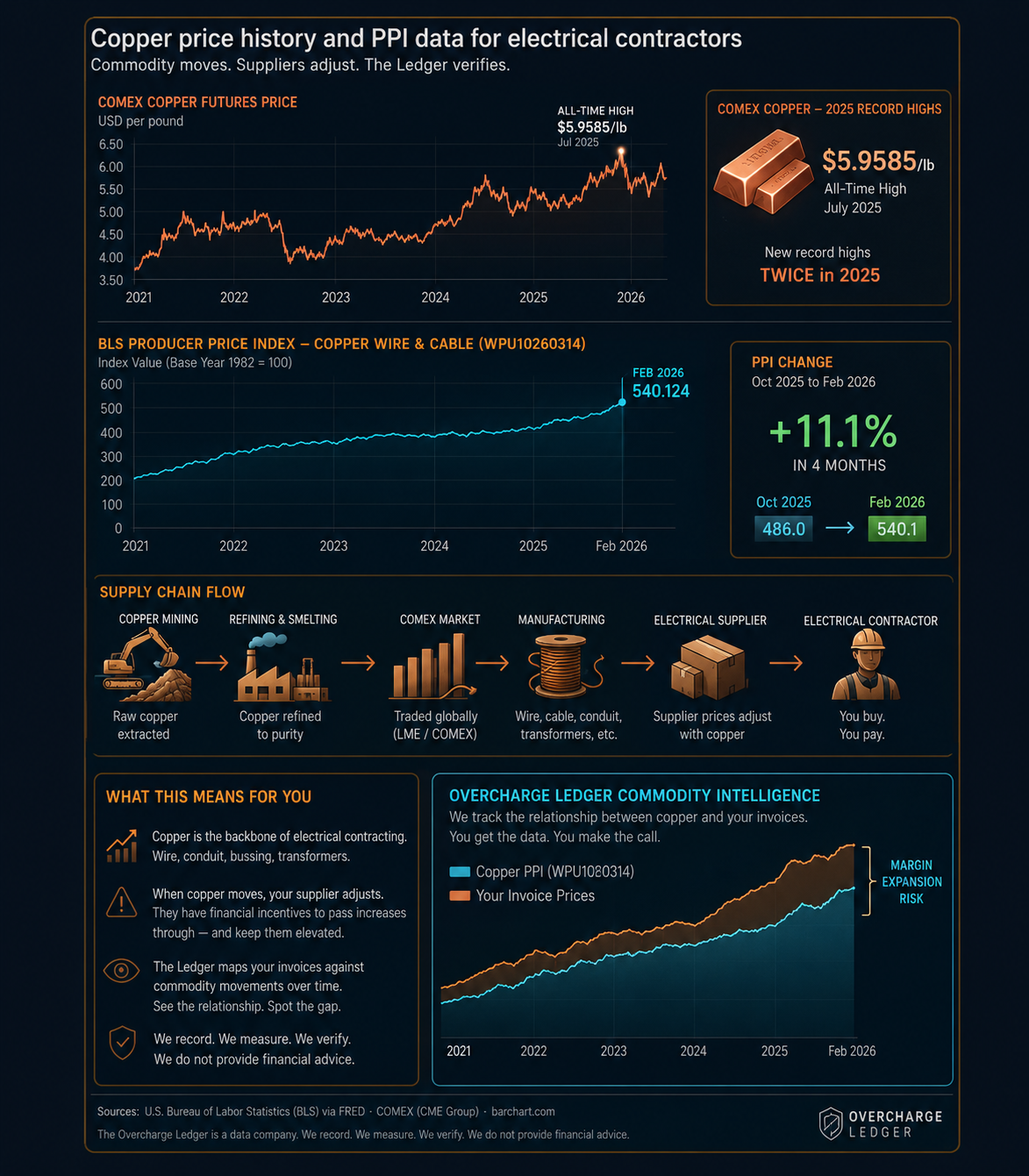
Copper is the backbone of electrical contracting. Wire, conduit, bussing, transformers — the majority of what you buy from your electrical supplier is priced against copper spot. When copper moves, your supplier adjusts. The question is whether your invoices reflect market reality or supplier margin expansion.
The BLS Producer Price Index for Copper Wire and Cable (FRED series WPU10260314) moved from 486 in October 2025 to 540 in February 2026 — an 11% increase in four months. COMEX copper futures hit new record highs twice in 2025, reaching $5.9585/lb in July 2025.
Your supplier has financial incentives to pass those increases through — and financial incentives to keep prices elevated even when the commodity pulls back. The Overcharge Ledger is building commodity intelligence into every client dashboard so you can see the relationship between what copper is doing and what your invoices say. We are a data company. We record. We measure. We verify. We do not provide financial advice.
When copper moves 11% in four months, your supplier's system knows. The Ledger maps your invoice prices against commodity movements over time so you can see whether price increases on your invoices track the underlying commodity — or whether your supplier is expanding margin on top of it. We record the data. You decide what to do with it.
These are not hypothetical. Every pattern below has appeared in active electrical contractor engagements. The examples are real finding types, not illustrations.
You quoted 12 AWG. The invoice shows 10 AWG. Same job description, different conductor cross-section — and a different price that wasn't agreed to. 94–99% description match means a human will not catch it on a manual review.
EMT, IMC, and rigid conduit have different price points. A specification swap — same diameter, different conduit type — runs through the invoice invisibly. The description says "conduit." The SKU says something different.
Panels and breakers are quoted once at project start. By the time the third delivery arrives, the per-unit price has quietly moved. No line item flags it. The aggregated total across the job tells a different story.
Your supplier adds a copper surcharge to cover commodity exposure. Copper pulls back. The surcharge doesn't. It becomes a permanent line item while the commodity it was justified by moves in the opposite direction.
Fixtures, devices, and specialty items delivered without a quoted price. Your supplier sets the number at time of invoice. In electrical work, these unquoted items can represent a significant share of total materials spend.
The same delivery charged twice across two invoices weeks apart. Volume and multiple delivery schedules across multiple jobs make this pattern nearly impossible to catch manually. The Ledger holds your full invoice history simultaneously.
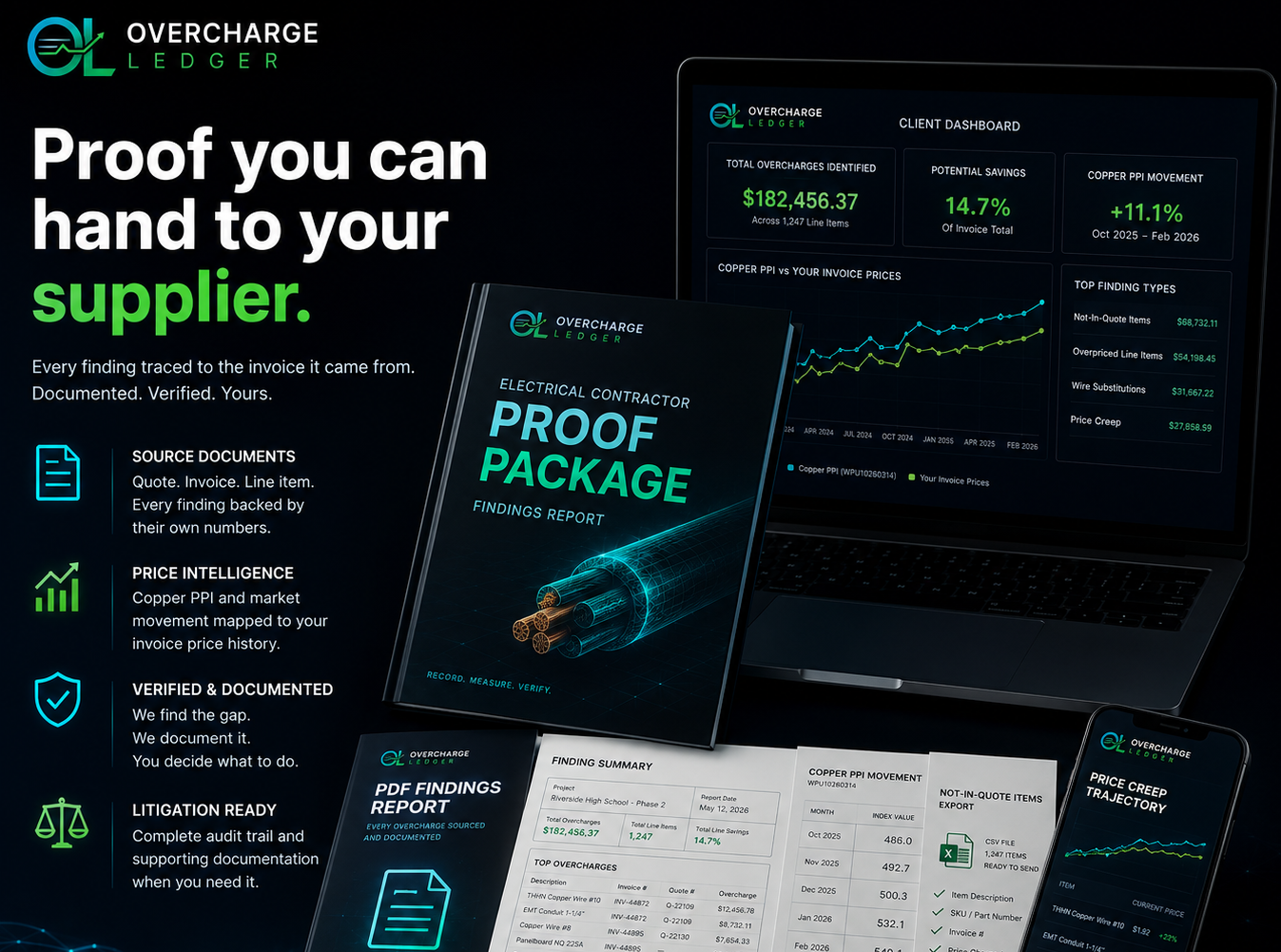
The Ledger produces a complete proof package — every discrepancy documented back to the source document. Quote. Invoice. Line item. Dollar amount. Ready to hand to your electrical supplier or your attorney.
Your supplier cannot argue with their own document numbers. That is the point. We find the gap. We document it. What you do with it belongs to you.
Monthly service. Flat rate. Cancel anytime. No contract required to start.