

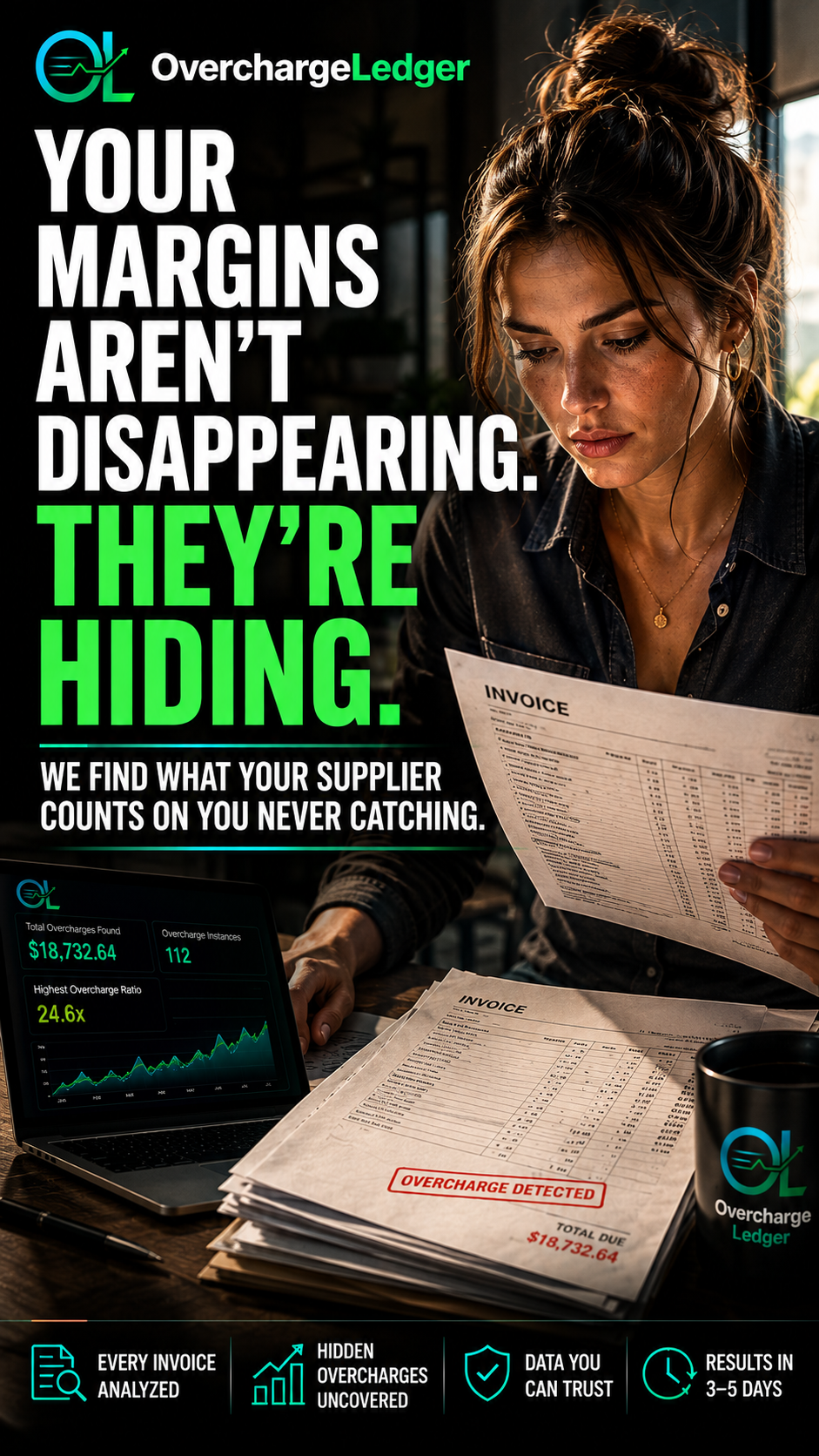
You run jobs, manage crews, hit deadlines, and keep suppliers moving. Nobody has time to read every invoice against every quote — and your supplier's billing system was built knowing that. That is exactly why the Overcharge Ledger exists.
Some of your supplier relationships are solid. Some of them irritate you but the job has to get done and they're the ones who can deliver on time. Either way, the invoices keep coming. Your AP team is buried. Your project managers are focused on the field. And somewhere between the quote that helped you price the job and the invoice that hit your desk weeks later, the numbers shifted.
Nobody in your office has time to check every single line item of every single invoice against every line item of the same supplier's quote — across every job, every supplier, every month. Even if someone is doing it, the volume makes errors inevitable and cutting corners easy.
That is not a failure of your team. It is exactly the environment your supplier's billing system was designed to operate in.
You quoted the job. You won the bid. You started the work. Your supplier delivered materials and the invoices started arriving — sometimes weekly, sometimes as the job runs. Your AP team processes them. Your bookkeeper files them. And the margin you built into the job starts quietly shrinking.
50 invoices a month. 200 line items each. Multiple suppliers. Multiple jobs running simultaneously. A human being checking every line against every quote would need to do nothing else. Nobody has that person. The Ledger does.
Even if you assigned someone to this, invoice auditing is monotonous, detail-heavy, and exhausting. Fatigue creates errors. Errors create exactly the gaps your supplier's system already lives in.
Nobody at your supplier is hand-writing invoices anymore. Their pricing, billing, and product catalog runs through software — software that has financial incentives to maximize margin on every order. The overcharges are almost never on the big-ticket items. Those are too easy to spot.
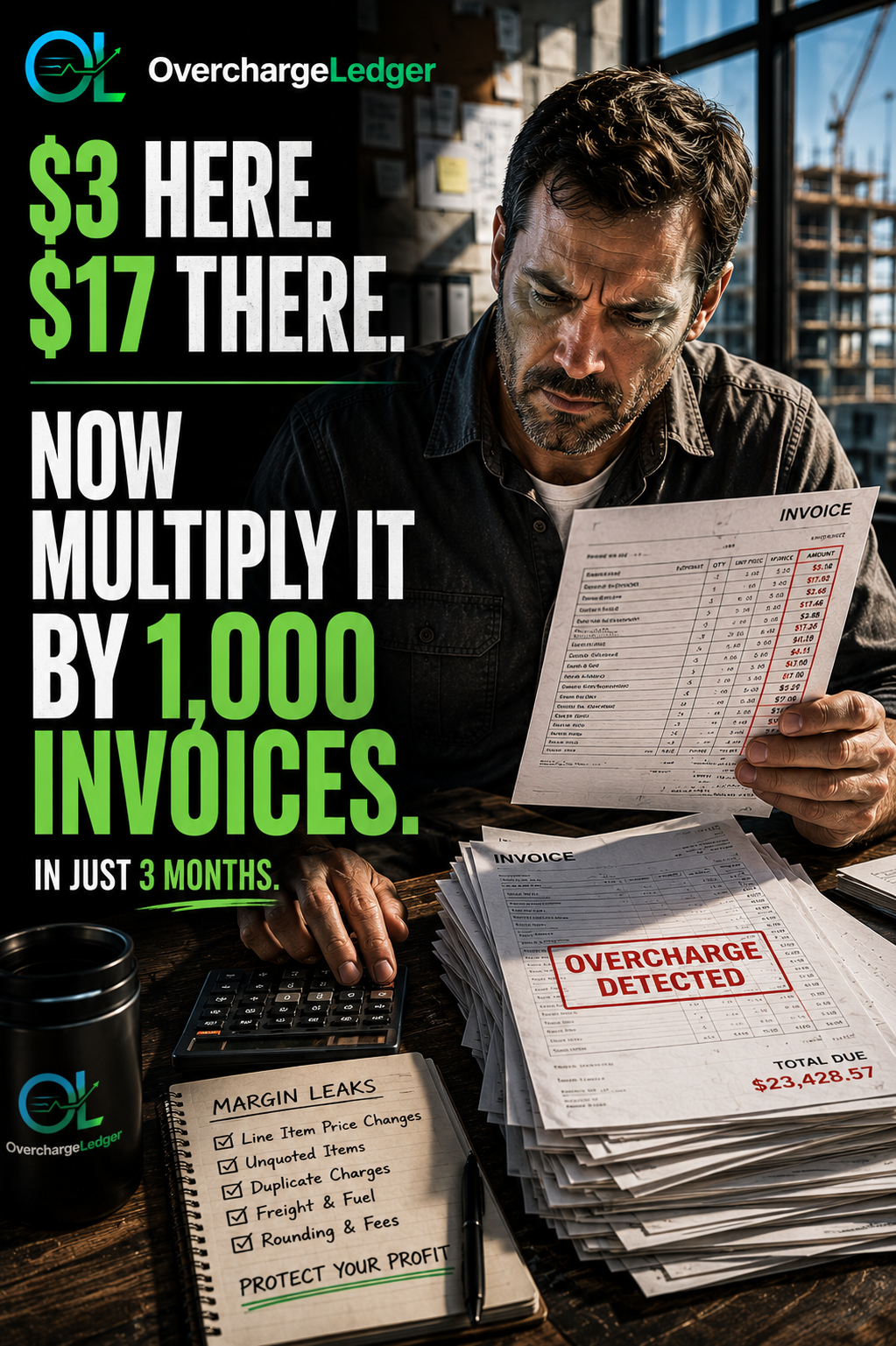
The damage is on the small items. A few pennies here. A few dollars there. Compounding across hundreds of line items, dozens of invoices, multiple suppliers, multiple jobs. Death by a thousand cuts — every cut sized specifically to survive a manual review.
You've probably felt it for years. Maybe you've caught an overcharge here and there. Maybe you have the experience to know that a quarter-inch PVC coupling shouldn't cost what they charged you, or that a copper-graded elbow fitting has moved up in a way that doesn't track with what copper is actually doing. That instinct is real. The Ledger takes that gut feeling and turns it into documentation.
"We have found that suppliers openly acknowledge that pricing discrepancies exist in their system. They admit they hope you don't find them. It is never the line item you'd expect — it is the one you'd never think to question."
Your first audit is free. We start with an onboarding conversation — you tell us which supplier feels wrong, which jobs didn't add up, what you've noticed over the years. We take that and we go to work.
We set up a secure private channel for your documents. We know the chaos. Invoices and quotes arrive in every format imaginable — and we've seen all of it. Whatever you've got, send it.
We create supplier folders and job folders for you. Drop everything into the right folder or just drag it all in — we'll sort it. If you have physical documents, we'll walk you through how to scan and send them. Nothing gets lost. Nothing gets skipped.
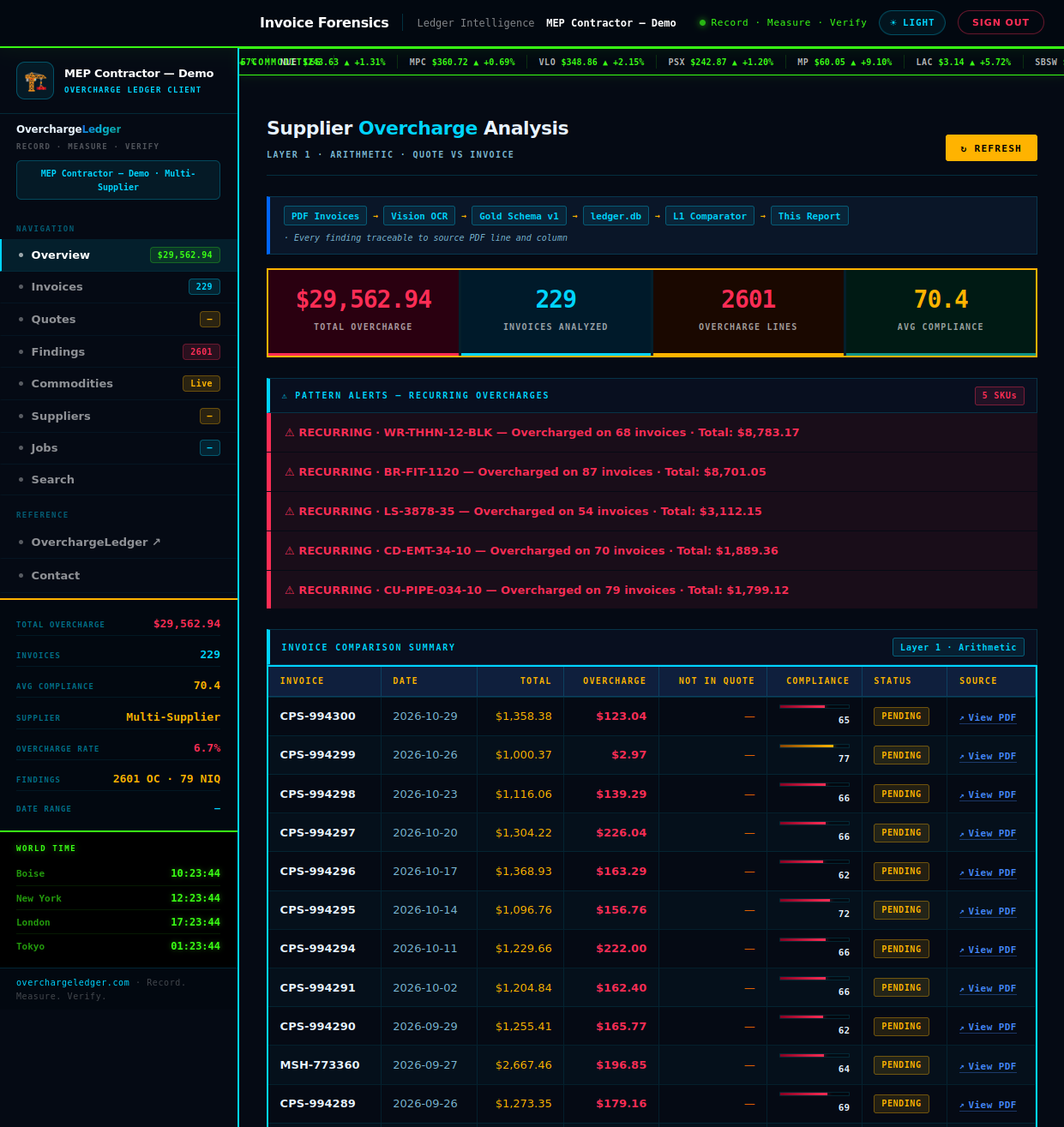
Once your documents are in, you get access to your Ledger account and CRM. Every invoice you've sent us. Every quote. Organized by supplier and by job. You can see exactly where every document sits in the process at any time.
While you're running your business, the Ledger is running behind it. Ruthless. Systematic. The exact kind of system every business owner wishes was watching their back at all times — checking every line, every quantity, every SKU, every price against the full history of what your supplier actually agreed to charge you.
These are not edge cases. Every one of these patterns has appeared in active client engagements. The Ledger is built to find all of them — simultaneously, across your full document history.
The invoiced price is above what was quoted. Small per unit. Significant across twelve months.
Same description. Different SKU. Different grade, different size — a price multiplier of 6× to 29×.
Billed for more units than ordered or delivered. Volume is the cover. Manual verification can't catch this reliably.
The same item charged twice — sometimes weeks apart, hidden in volume. Designed to look like clerical error if caught.
Small incremental increases — 2%, 4%, 7% — compounding over months. No single invoice shows the damage.
Items delivered with no agreed price. Your supplier sets the number unilaterally. In one case: 74.9% of total spend.
Here is the moment where the power dynamic between you and your supplier changes. Your supplier quoted you a half-inch PVC pipe at $2.03. The job demanded one-inch pipe — and on the invoice, one-inch shows up at $8.23. Same product description. Half an inch bigger. Four times the price. Before the Ledger, there was nothing to compare it to. You paid it and moved on.
The Ledger makes your supplier confront that gap in a way you have never had access to before. Every discrepancy is traced back to the exact invoice and quote it came from. Source document. Line item. Dollar amount. There is no "that must be an error" when the evidence is sitting in front of them.
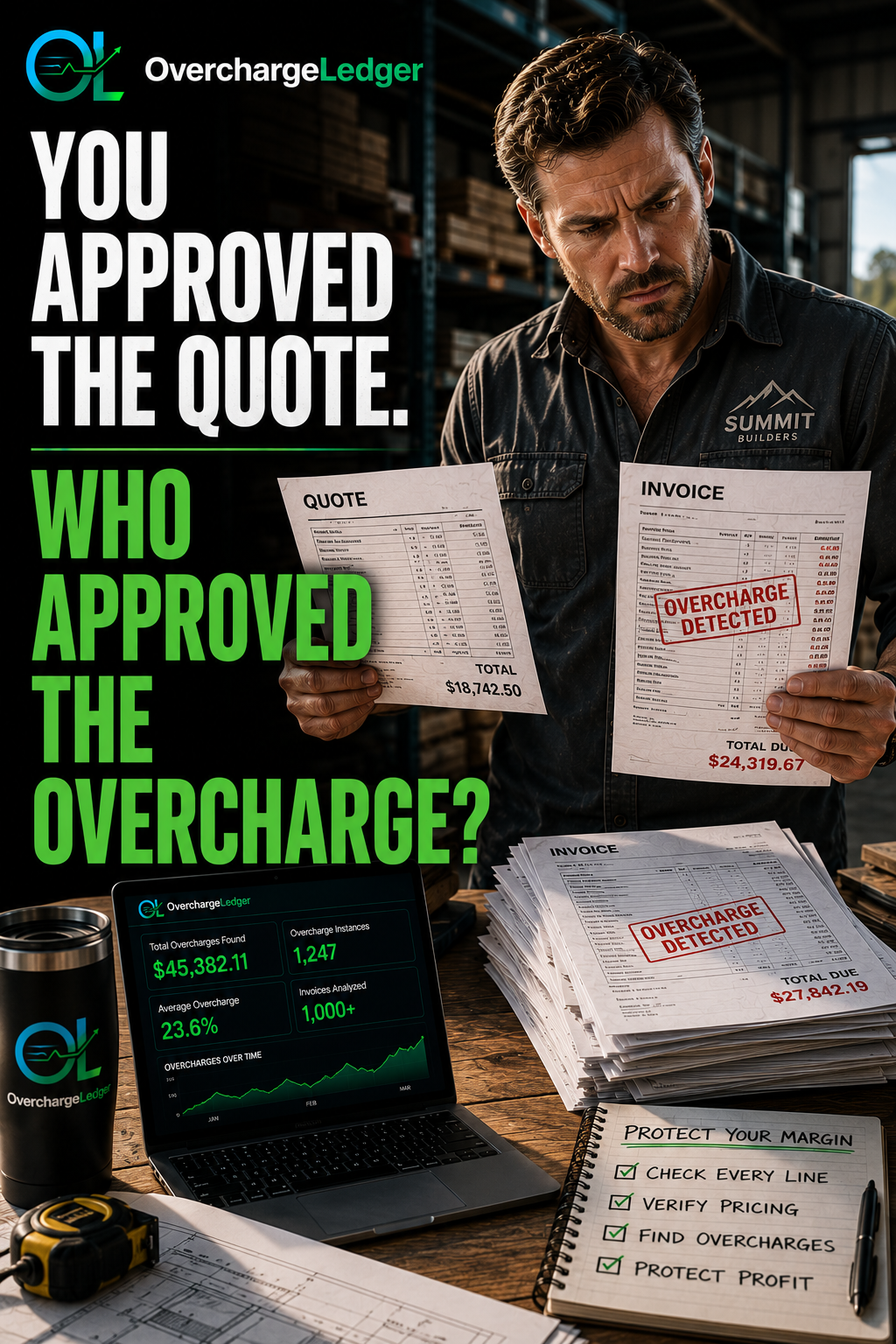
74.9% of your spend may have no quote on record at all — meaning your supplier has been setting prices unilaterally on the majority of what you buy from them. The Not-In-Quote export changes that immediately. You send it to them. They have to add those items to your future quotes at an agreed price. That alone changes the relationship.
Every export from the Ledger is built for a specific audience — your AP team, your supplier, or your attorney. You choose which one you need and when.
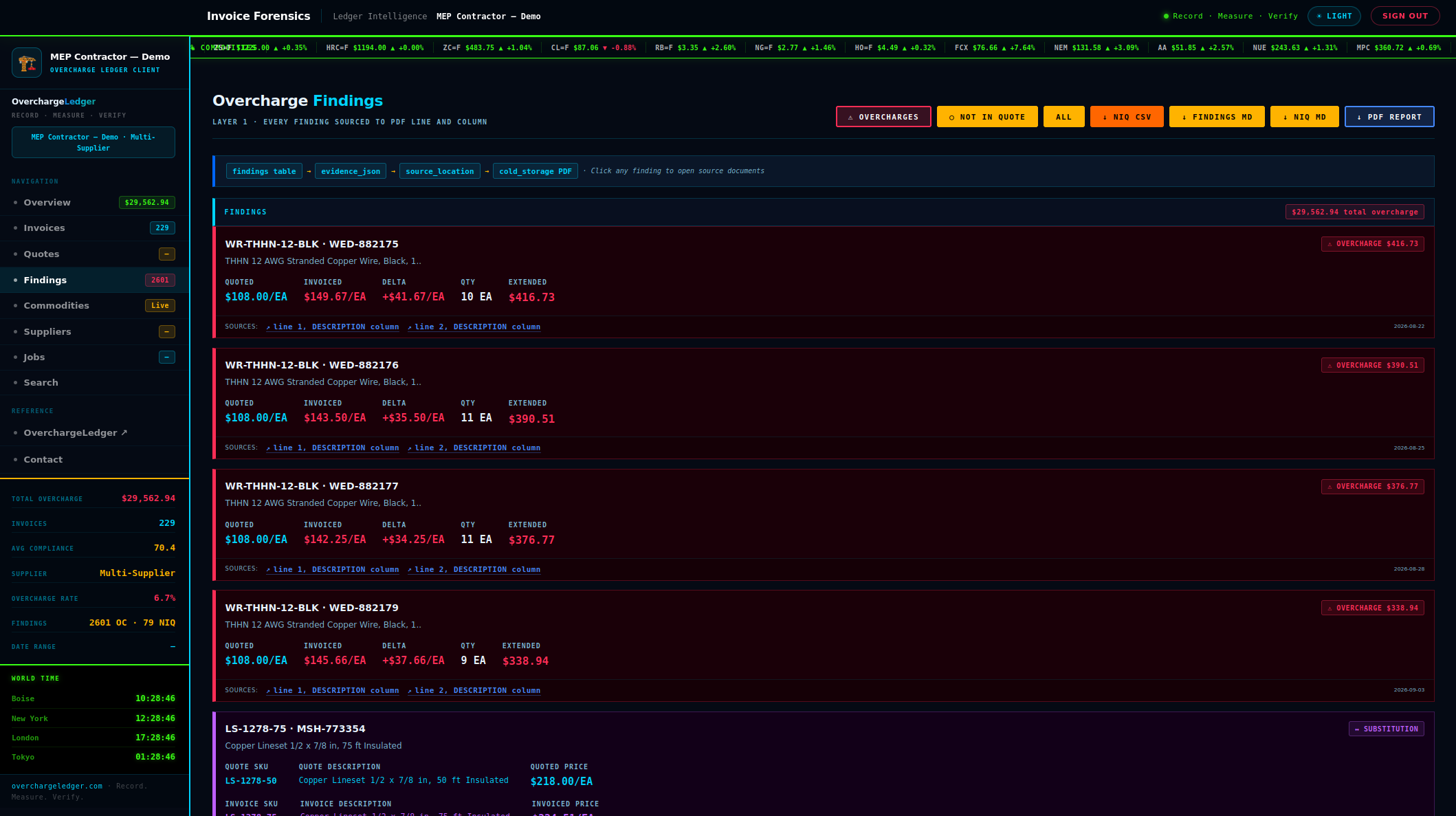
Every item billed that was never on your supplier's quote — exported as an Excel-compatible spreadsheet. Send it directly to your supplier or their accounting team. They have to respond to it.
Every overcharge and substitution metric the Ledger found — formatted as a clean text file. Structured for your records, your bookkeeper, or your legal team. Every finding sourced.
Every item not found on your supplier's quote — in a clean markdown text file. Ready to hand to your supplier or attorney. Organized by invoice and by line item.
Every finding and overcharge inside a formatted PDF. Download it. Hand it across the table. Your supplier cannot argue with their own document numbers. Designed for supplier credits, renegotiation, or litigation.
When the sales rep walks into your office with the branded hats and the handshake — open your Ledger account. Every number. Live. Sourced. Documented. That conversation is different now.
They will be uncomfortable. That is not your problem — it is leverage. We have helped ongoing clients walk their suppliers through findings when needed. We do not disappear after the report. If you need us in that room — or on that call — we can do that.
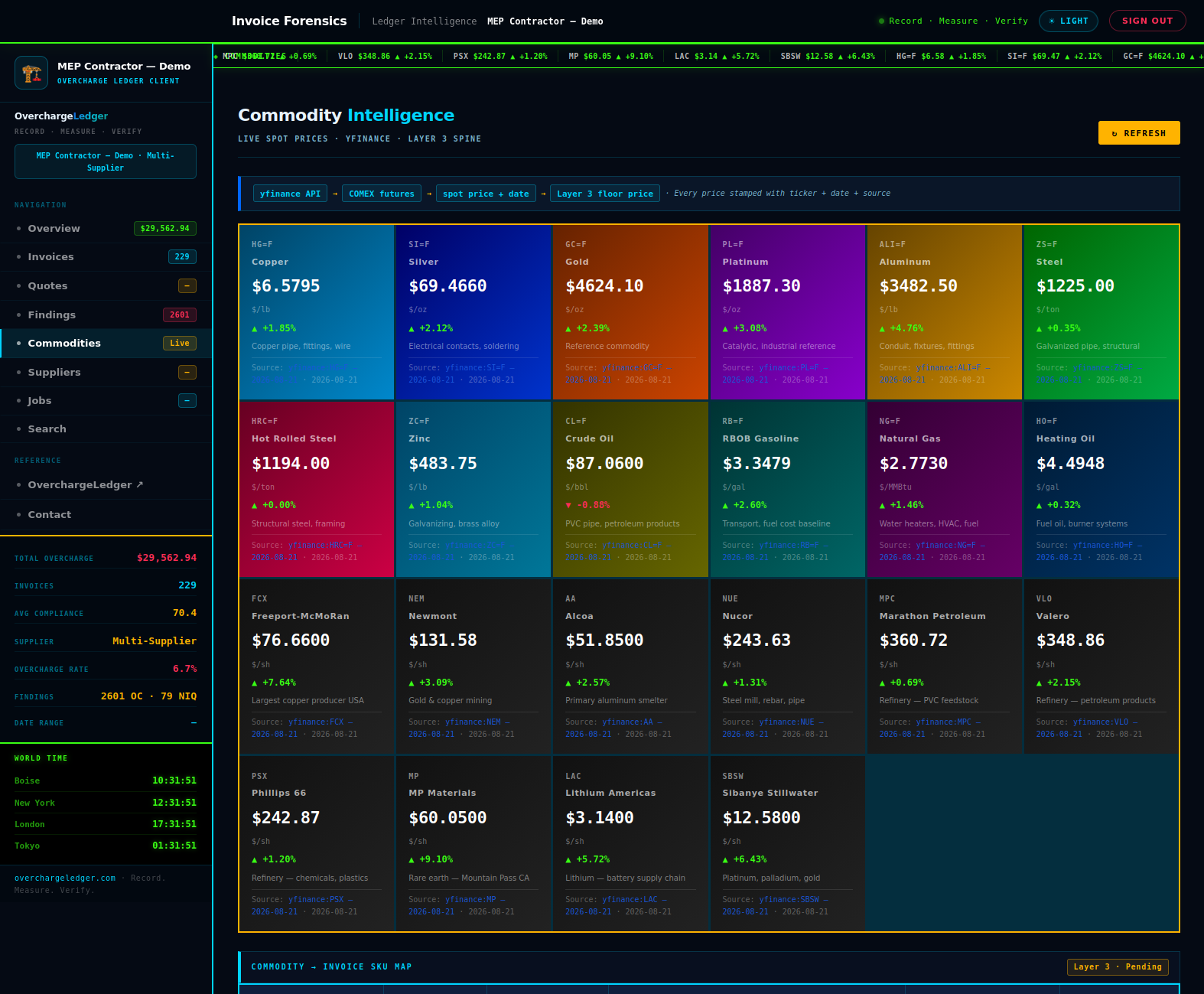
When your supplier tells you prices are up "because of the economy" — that is a story. The economy is based on mathematics, supply and demand, and commodity pricing at the base layer. The Ledger is building the intelligence to map that for you.
The products your suppliers invoice you for are typically made of base commodities. When those commodity prices move — up or down — you will be the first to know. Which means you can time your material purchases better, negotiate from a position of data, and call your supplier on the gaslight before it lands on your desk as a price increase.
This is in active development. Ongoing clients will receive commodity intelligence briefings as features ship — included in your monthly service at no additional cost.
The Overcharge Ledger was built from first-hand experience inside a public works contractor. The chaos of a busy construction office is real — the deadlines, the document pile, the AP team stretched thin across too many jobs. And so is the way one small overcharge, compounding quietly across months and suppliers, can destroy the margins on a job that looked profitable on paper. Your margins are everything. The leverage to protect them is already hiding inside your own documents.
We will walk you through exactly what it finds and how it works — using your own documents. No sales pitch. No software to install. Email us or call us directly and we will set it up.
Monthly service. Flat rate. Cancel anytime. No contract required to start.